
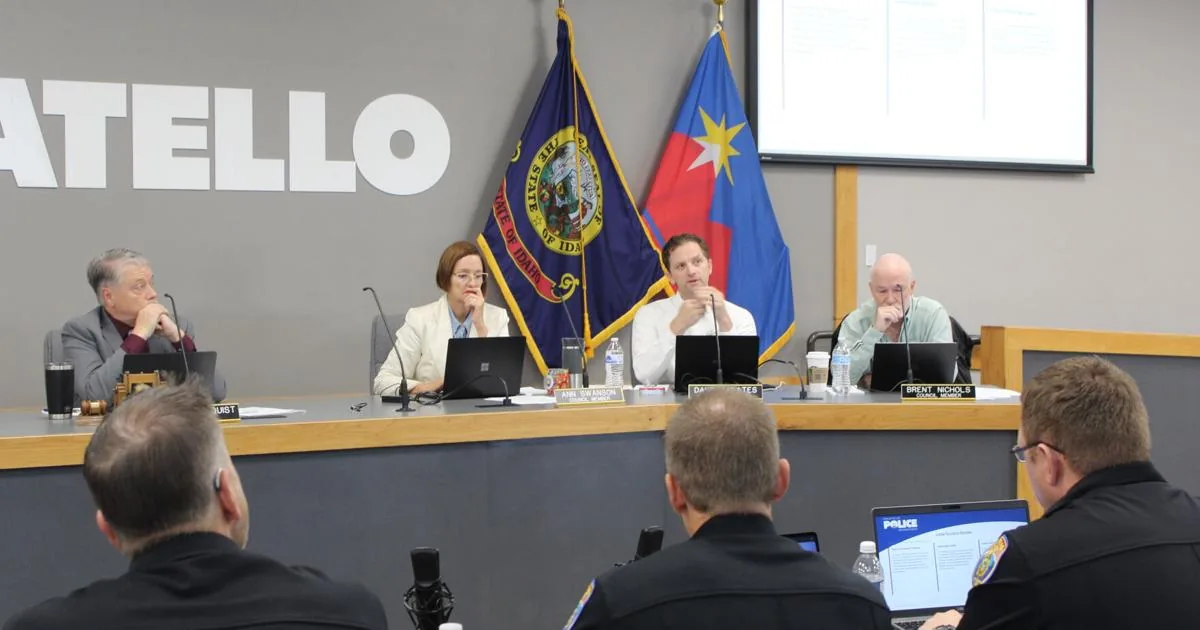
POCATELLO, ID — Pocatello police and a Flock Safety representative spent a City Council work session Thursday defending the city’s license plate reader cameras, a discussion that came less than two weeks before a public town hall on the technology.
No formal vote was taken in council chambers at City Hall, but the meeting made clear that the city is headed toward a broader public debate. Councilman Hayden Paulsen is gathering signatures for a ballot initiative that would end the city’s contract with Flock, while Councilman Dakota Bates said he wants the cameras to remain in place with stronger safeguards and closer oversight.
The town hall is scheduled for 6 p.m. Oct. 21, and city leaders said they want residents to hear the arguments directly. Police also used the meeting to walk council members through how the cameras work and why they say the system has helped solve cases.
Paulsen pushes a ballot drive after doubting the council will act
Paulsen told fellow council members he does not believe a majority will vote to end the contract, which is why he is moving ahead with a ballot initiative. He said he would prefer a straightforward council vote, but does not expect that outcome.
He said the first round of signatures is being checked and that about 15 days remain in that verification step. Paulsen said the initiative will likely need between 2,000 and 2,500 signatures to qualify, but because of possible errors he is trying to collect 3,000 to 3,500.
The 180-day filing window began about a week and a half ago when he submitted the paperwork to the city clerk. Paulsen said the process must be finished by April 30 and will include ballot-language work with the city attorney. He said a council vote could come as soon as next month, though it might not happen until January 2027.
Bates backs the cameras but wants tighter guardrails
Bates said he does not support an outright ban because he believes the technology has value, especially when the city can review and adjust its rules over time. He said routine oversight is the right way to handle a tool that is still relatively new.
At the same time, Bates said he understands why some residents are uneasy and believes privacy protections should stay in place. He said the city should keep looking for ways to narrow how the cameras are used and should consider whether every stolen-vehicle case needs to be entered into the system.
He also said he does not want the city to eliminate a tool that might one day solve a serious crime or save a life. Bates described the issue as a balance between privacy and public benefit, and he said that balance has to be revisited often rather than settled once and for all.
Police point to arrests, missing people and limited staffing
Police Chief Roger Schei, Maj. Eric Anderson and Capt. Zac Bartschi returned to answer follow-up questions from an Aug. 13 meeting, when council members first pressed the department about the city’s 36 cameras. That earlier discussion came amid vandalism of cameras locally and elsewhere.
Schei said the department has about 10 patrol officers on the street at a time, which makes the cameras especially useful as an extra set of eyes. He said the system helps officers solve crimes, keep the public safe and hold people accountable.
Police cited cases in which the cameras helped locate missing and endangered people, including a vulnerable adult who left Pocatello and was found out of state. Officers also described using the system to track an escaped inmate passing through the area.
How the Flock system works and what officers say it does not do
According to police, the cameras capture a vehicle’s license plate, along with the time and location, while it is on a public road. That information can be searched for up to 30 days.
Officers said the system does not use facial recognition or identify drivers. They also emphasized that an alert from the cameras is only a lead and still has to be verified by officers; it is not probable cause by itself.
That distinction mattered during the work session as council members asked what the city can and cannot do with the information. Bates said he wanted the contract changed so Flock cannot disclose Pocatello data to outside parties without the city’s permission.
Cases cited by police included domestic violence and child exploitation investigations
Police described a felony domestic battery case in which officers added a suspect’s vehicle to a hot list. Two days later, a camera alert showed the car moving toward the victim’s home, and officers intercepted it and made an arrest.
In another case, investigators used a plate reader to identify the registered owner of a truck seen leaving a Pocatello convenience store. Police said that vehicle was linked to a man accused of touching a girl inappropriately, and the man was later arrested on a child sexual abuse charge.
Officers also said the cameras helped locate an endangered juvenile. Schei said those examples show why his department views the system as a practical crime-fighting tool rather than just a data-collection program.
Oversight changes, contract revisions and the Oct. 21 town hall
Police said they are moving from quarterly audits to monthly audits, and the results will be posted to the department’s transparency portal. Flock representative Sheerica Ware, who joined by phone, said the company has replaced one disputed data-disclosure clause with another section that keeps ownership of the data with the city.
The contract language had already drawn scrutiny from Councilman Brent Nichols, and city attorney review is still needed before the updated terms can be attached. Bates said private hot lists should remain visible to the department’s administrative team, and he also said a citizen advisory board and continued council review are important.
Mayor Mark Dahlquist said the council should continue holding periodic work sessions. Both Paulsen and Bates said they want to hear from the public at the Oct. 21 town hall, which will run from 6 to 7:30 p.m. in the City Council Chambers at City Hall. Police will present first, followed by a question-and-answer session with three minutes for each speaker and sign-in beginning at 5:30 p.m. The meeting will be posted to the city’s YouTube channel the next day.